


Contact
Address: 11 Carol I Blvd., RO-700506 – Iași
Phone: +40 232 20 1050; 20 1051
Fax: +40 232 20 1150
E-mail: fizica@uaic.ro
Website: http://www.phys.uaic.ro/
Dean: Prof. Univ. Dr. Ionuț-Cristian TOPALĂ
Vice Dean: Lect. Univ. Dr. Cătălin AGHEORGHIESEI
378 students
36 tenured faculty members
65 associated faculty members

Departments
Director: Assoc. Prof. Dr. Iordana AȘTEFĂNOAEIDirector: Prof. Univ. Dr. Diana MARDARE
Specializations
University Studies- Bachelor’s degree
- Physics (6 semesters)
- Physics (FT – Full-time / IF)
- Medical Physics (FT – Full-time / IF)
- Computer Physics (FT – Full-time / IF)
- Applied Engineering Sciences (8 semesters)
- Technological Physics (FT – Full-time / IF)
- Technological Physics (dual education) (in Focșani) (FT – Full-time / IF)
- Technological Physics (Bălți – Republic of Moldova) (FT – Full-time / IF)
- Physics (6 semesters)
- Master’s degree (4 semesters):
- Physics
- Biofizică şi fizică medicală / Biophysics and Medical Physics (in English) (FT – Full-time / IF)
- Applied Physical Methods in Physical Therapy and Medical Recovery (FT – Full-time / IF)
- Physics Applied in Information and Communication Technologies (Bălți – Republic of Moldova) (FT – Full-time / IF)
- Fizică pentru tehnologii avansate / Physics for advanced technologies (in English) (FT – Full-time / IF)
- Optics and Optometry (FT – Full-time / IF)
- Applied Medical Physics (FT – Full-time / IF)
- Physics Applied in Smart Technologies and Communications (FT – Full-time / IF)
- Fizica energiilor înalte / High Energy Physics (HEP) (in English) (FT – Full-time / IF)
- Physics
- Doctoral degree (6 semesters)
- Physics
Overview
Physics constitutes one of the vanguard fields of the “Alexandru Ioan Cuza” University of Iași, through the integration of teaching activity with scientific research, development, innovation, and knowledge transfer activities to society, supported by a tradition of over a century and a half. Physics education in Iași finds its roots within the Mihăileană Academy, where as early as 1835 there was a strong current of concern for the study of natural sciences. Following the foundation of the first modern higher education institution in Romania, the “Alexandru Ioan Cuza” University of Iași (1860), where the first physics professor was Ștefan Micle, physics departments were coagulated and developed under the guidance of personalities such as: Petru Bogdan, Dragomir Hurmuzescu, Horia Hulubei, Theodor V. Ionescu, Ștefan Procopiu, Șerban Țițeica, Constantin Mihul, and Teofil T. Vescan. Thanks to these great personalities of physics and their continuators – Ilie Bursuc, Vasile Tutovan, Mircea Sanduloviciu, Constantin Păpușoi, Mardarie Sorohan, and Ioan Gottlieb – the Faculty of Physics, established as an independent unit in 1962, has experienced continuous development.As the basis of all modern technologies and with answers for phenomena ranging from the nanoscopic level to the scale of the Universe, Physics constitutes a fundamental discipline in modern society, with various applications in technical and smart specialization fields, energy and materials of the future, space sciences, life and Earth sciences, etc. Today, the faculty proposes bachelor’s programs in “classic” fields of physics as well as interdisciplinary directions. Across all specializations, emphasis is placed on the study of physics as a fundamental discipline, with the acquired knowledge to be applied in interdisciplinary fields such as: nanotechnologies and materials science (Physics, Technological Physics), medicine and biotechnologies (Medical Physics, Biophysics), and information and communication technology (Computer Physics). These are complemented by master’s programs taught in English in advanced fields of physics or in Romanian in professional fields requiring advanced knowledge of physics, along with a doctoral study program. Students’ specialized practical training takes place both in the faculty’s laboratories and within institutions or companies with which partnership agreements have been concluded.
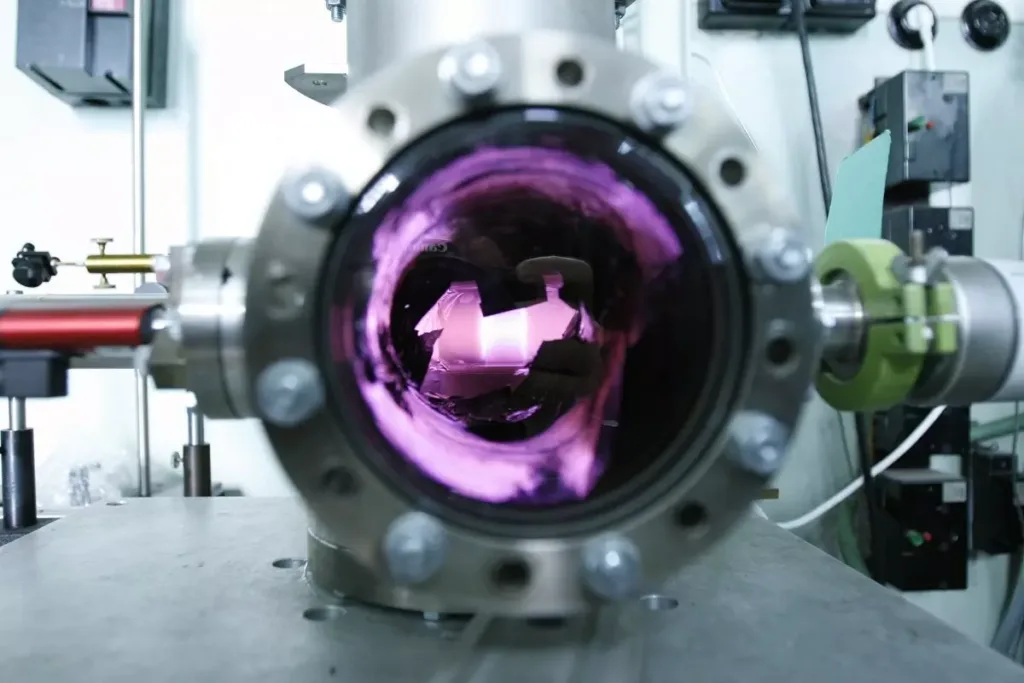
Scientific research conducted by the staff of the Faculty of Physics addresses various fields, such as bio-nanotechnologies, information and communication sciences, biophysics, medical physics, plasma physics, surface and interface physics, innovative materials, and theoretical physics. The Faculty of Physics is known internationally for results published and cited in the world’s most prestigious scientific journals.
Four research centers operate within the faculty with outstanding national and international results, where teaching staff and students from all study cycles carry out their activities:
- CARPATH Center of Excellence – Center for Applied Research in Physics and Advanced Technologies (recipient of the award granted by the Ministry of Education and Research for the best university research group in Romania);
- Center for Advanced Research in Plasma Physics in Iași – IPARC;
- Center for Advanced Experimental and Theoretical Research in Condensed Matter Physics;
- Center for Advanced Research in Life Sciences and Nanosciences.
The European Physical Society (European Physical Society – EPS) granted the Faculty of Physics of the “Alexandru Ioan Cuza” University of Iași (UAIC) the symbolic status of “historic site” in recognition of the role played in shaping the world of modern physics. On this occasion, a bilingual plaque was placed in the main building of UAIC, unveiled during a ceremony that took place on May 22, 2023, by the EPS representative, Prof. Goran Djordjević, member of the EPS HS committee. During the ceremony, messages from Professor Luc Bergé, EPS President, Professor Karl Grandin, Chair of the EPS Historic Sites Committee, as well as those of Prof. Djordjević were conveyed and appreciated by all participants.
The EPS initiative to identify historic sites of physics has the ambitious objective of raising awareness that not only artistic cultural heritage and natural heritage should be preserved for humanity, but also scientific cultural heritage.
At this moment, over 70 sites from 25 countries are included in the program: Austria, Belgium, Bulgaria, Croatia, Czech Republic, Denmark, Finland, France, Germany, Hungary, Italy, Ireland, Israel, Lithuania, Netherlands, Norway, Poland, Portugal, Romania, Russia, Spain, Sweden, Switzerland, United Kingdom, and the United States of America. From Romania, the Măgurele Physics Platform was previously recognized in 2017 by the European Physical Society as a historic site.
The Physics Library is located in building A of the University, ground floor, 11 Carol I Blvd., 700506, Iași, E-mail: bib.fiz@uaic.ro, Phone: +40 232 20 1151
Demonstrative Courses for High School Students

Useful links
News
- Young volunteers from 11 countries participate in archaeological research at the eponymous site of the Cucuteni – Cetățuia culture
- UAIC organized “Open Doors Day” at the “Ion Gugiuman” Rarău Research and Student Practice Station
- Over 20,000 application files submitted for the 2026 admission at UAIC across the two enrollment sessions





 Facultatea de Fizică, Universitatea „Alexandru Ioan Cuza” din Iași, Bulevardul Carol I, Nr.11, Corp A Iaşi, România, Telefon: +40 232 201050, E-mail: fizica@uaic.ro