


“… ever since its foundation, the University of Iași felt the need to integrate itself into history, to embrace the spirit of history in order to deepen its specific character and more effectively fulfill its functions.”Acad. Prof. Gheorghe PLATON, Ph.D.
A history of the University of Iași takes us through the lessons of the Romanian history textbook, all the way back to the 16th century. While the existence of a university is generally tied to the historical context, in Romania the University of Iași has often played the role of a creator of history. In the 17th century, for instance, the university was a sanctuary for Byzantine culture; later, it was one of the most important drivers for the spread of the Romanian language and native culture; following its establishment as Romania’s first modern higher education institution, the university provided the state with its most important thinkers and actors in public life, and during the communist period, it kept the humanist spirit alive.
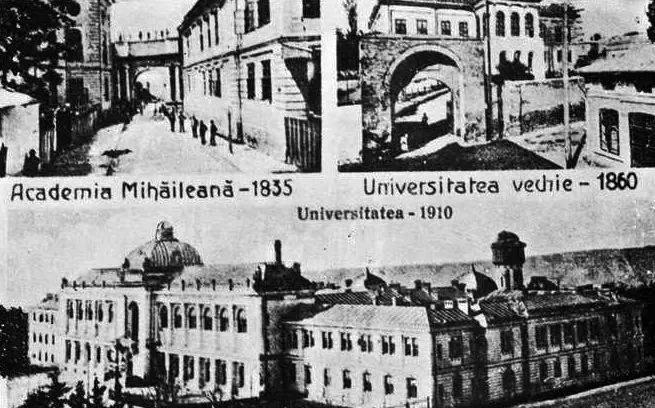
Before 1860
Founding Act of the 'Vasile Lupu' College at the Three Hierarchs Monastery
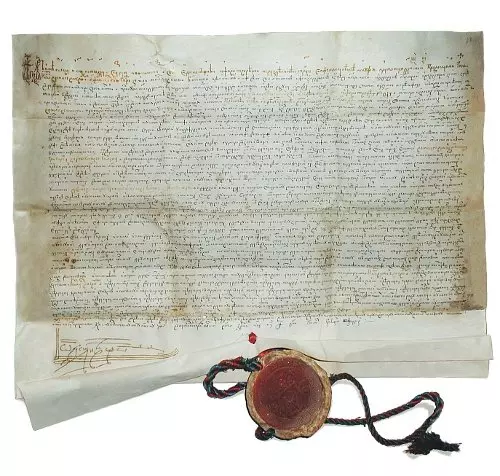
The original founding act of the College at the Three Hierarchs Monastery in Iași by Voivode Vasile Lupu on May 9, 1640. The document is written on parchment, features gilded lines and words, and was recently discovered at the Iveron Monastery on Mount Athos by Professor Petronel Zahariuc from the Faculty of History of our University.
The transcription of the act can be read here.
After 1860
Founding Act of the University
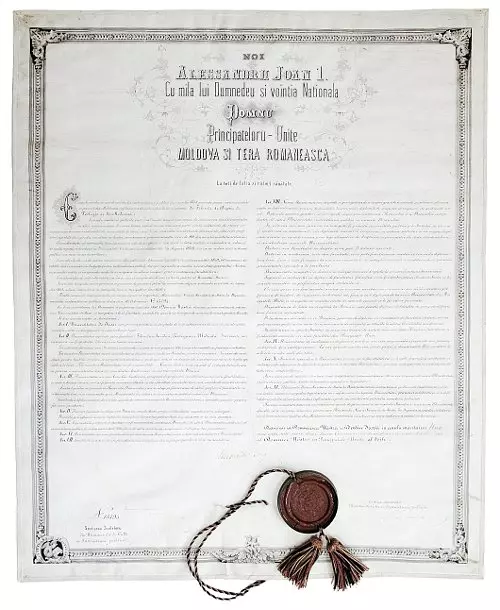
From its foundation to the present day, the structure of the University of Iași has been in a continuous state of change, in harmony with the evolution of Romanian society and culture.
Initially, the University comprised only three faculties: the Faculty of Philosophy, Law, and Theology. Following the Education Law of 1864, the University was reorganized into four faculties: the Faculty of Letters and Philosophy, the Faculty of Physical, Mathematical, and Natural Sciences, the Faculty of Law, and the Faculty of Medicine, inaugurated only in 1879. After operating for just a few years, the Faculty of Theology was dissolved due to its low number of students. Stimulated by a new law in 1898, the University of Iași managed to diversify its profile, increase its number of sections, departments, taught subjects, and scientific activities. During that period, a spectacular development of the Faculty of Sciences stood out: in 1892, the Departments of Organic Chemistry and Inorganic Chemistry were established, joined in 1906 by Agricultural Chemistry. Within the same Faculty, a major success was the creation of the School of Electricity in 1910. Following its modest beginnings in 1879, the Faculty of Medicine acquired, in 1889, an organization and profile that enabled the training of highly qualified specialists capable of meeting the social demands of those times.
The period immediately following the National Union of 1918 was characterized by the remarkable evolution of the University, in accordance with the requirements of Romanian society and European progress at the time.
The Education Laws of 1932, 1937, and 1938 favored both the evolution of sciences and the development of the University’s departments: Medicine and Pharmacy, Sciences, Law, Philosophy and Letters, and Agriculture. In 1933, the agricultural education subsection, included in the applied sciences section, was transformed into the Faculty of Agricultural Sciences. The other two branches of the section (the Electrotechnical School and the Technological Chemistry Section) were reorganized in 1937, giving birth to the “Gheorghe Asachi” Polytechnic Institute of Iași, which was joined by the Faculty of Agricultural Sciences a year later.
During the interwar period, the „Alexandru Ioan Cuza” University could proudly claim to have reached the level of European institutions of the same rank, both in terms of administration and organization, and in terms of curricula.
After the Second World War, the people’s democratic regime forced universities to promote education in a communist spirit. The education reform of 1948 imposed the first steps to fulfill this task, followed by the reforms of 1968 and 1978. Communist ideology brought radical changes to the University of Iași, as well as to the entire higher education system in the country. Many disciplines were censored or eliminated, numerous curricula were subjected to extreme rigidity, academic freedom was restricted, and all activities were guided or verified by bodies of the single existing political party.
Also during this period, due to an increasing demand for specialists in economics, the need arose to establish the Faculty of Economic Sciences (1962), following long years in which courses in Political Economy, Economic Doctrines, and Public Finance had been taught within the Faculty of Law.
Thus, in the 1968–1969 academic year, there were already eight faculties (Mathematics-Mechanics, Physics, Chemistry, Biology-Geography, Law, Philology, History-Philosophy, Economics), while in 1974 there were only seven, due to the transfer of the Faculty of Chemistry to the Polytechnic Institute.
The fall of the totalitarian regime in 1989 opened new perspectives on instruction and education in Romania. The organizational and curricular forms that had been imposed were immediately abandoned. The reconstruction of the university was spontaneous and radical, encompassing all fields: organizational structure, curriculum, communication system, and human resources. University autonomy and decision-making freedom have guided the „Alexandru Ioan Cuza” University toward what it is today: one of the top-performing universities in Romania, a standard for excellence in research and educational flexibility.
Rectors of the University from 1860 to the Present
UAIC Professors
The Dictionaries & Encyclopedias team of the Interdisciplinary Research Department in the Humanities created, in 2010, a catalog of the teaching and research staff of the „Alexandru Ioan Cuza” University of Iași from 1860 to 1990.
Each teaching staff member corresponds to a personal file in the database containing information such as: first and last name, highest academic rank identified, faculty/departments, periods of activity, leadership positions, and documentation sources.
The catalog of the teaching and research staff of the „Alexandru Ioan Cuza” University can be consulted here.
Useful Links




 Facultatea de Fizică, Universitatea „Alexandru Ioan Cuza” din Iași, Bulevardul Carol I, Nr.11, Corp A Iaşi, România, Telefon: +40 232 201050, E-mail: fizica@uaic.ro